Information For...toggle


Visit the Campaign for Social Sciences website

E-Newsletter Sign Up

Highlights & Special Offers


Special offer:
The Conservative Party
and social policy

£10 for May only

The Conservative Party and social policy cover

 With the recent focus on Margaret Thatcher’s legacy, this month we are offering The Conservative Party and social policy for just £10. Order your copy here.


Selected e-books
now just £6.99

Buy our most popular e-books at the special price of (around) £6.99, including Injustice, Democracy under attack and Hidden Stories of the Stephen Lawrence Inquiry.


New! Policy Press Bytes

Policy Press Bytes health inequalities cover

All three Policy Press Bytes from Danny Dorling's Unequal health are now available. Policy Press Bytes give you tasters of our most exciting titles on your e-book reader for just £1.99. Find out more here...


2013 Spring catalogue out now

Spring 2013 catalogue cover

Click on the cover to download a pdf (4.5MB) or request a print copy from tpp-marketing@bristol.ac.uk.


facebook logo    youtube logo   Twitter logo


Latest News

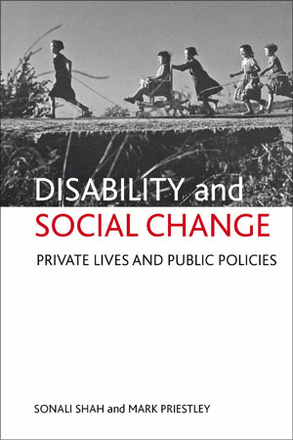
Disability and social change
Private lives and public policies

Author/Editor(s):
Sonali Shah, Mark Priestley
Format:
Paperback, 224 pages, 234 x 156 mm
ISBN
9781847427861
Published:
23 Mar 2011

£19.99 - List price: £24.99 You save: £5.00

Add this title to your basket

Own this title? Review it!

North America customers can order this book here from the University of Chicago Press.

"One of the best offerings in this field."
Journal of Social Policy
"A fascinating study in which more conventional histories of post-war disability are challenged through the skilful use of life stories."
Anne Borsay, Professor of Healthcare & Medical Humanities, University of Swansea

About This Book

Combining critical policy analysis with biographical accounts, this book provides a socio-historical account of the changing treatment of disabled people in Britain from the 1940s to the present day. It asks whether life has really changed for disabled people and shows the value of using biographical methods in new and critical ways to examine social and historical change over time.

Author Biography

Dr Sonali Shah is an academic researcher in the Centre for Disability Studies at the University of Leeds. This book is the result of a three-year New Career Development Fellowship she was awarded by the Nuffield Foundation. Mark Priestley is Professor of Disability Policy and Director of the Centre for Disability Studies at the University of Leeds. He is currently Scientific Director of the European Commission's Academic Network of European Disability experts (ANED).

Contents

Introduction
Disability and social change
Researching lives, telling stories
Family and friendship
Medicalisation and de-medicalisation
Education
Employment
Becoming 'disabled'
The past, the present and the future


ReviewsOwn it? Review it!

Disability and social change

This useful publication combines bibliographical accounts with critical policy analysis to great effect. Covering the period from 1940 to the present, it provides a socio-historical account of the changing treatment of disabled people in Britain in recent decades. The book explores how public policies and institutional care have influenced the types of life-choices and the opportunities available to people, whilst private resources have also been significant in both challenging and resisting policy initiatives.

One of the central questions to consider is if life has really changed for people with disabilities. The major strength of the book is that it highlights the value of using biographical methods in novel and critical ways in order to explore historical and social change over time. Through this book, researchers, students and policy makers are presented with new and different ways of exploring both historical and contemporary debates within disability studies and it is particularly recommended to these audiences.

Reviewed by Bridget Penhale
04

Disability and social change

This book offers insight into the changes in English policy and the impact on the lives, choices and life opportunities for children with physical disabilities over three generational cohorts from those born in the 1940’s, 1960’s and 1980s. The information is related through children’s personal histories linked to the changing legislation, policies and understanding of disability.

The book begins with a broad overview of the changes and differences in policies, understanding of disability alongside the collected personal histories and what the impact has been from the post war period up to the current day. The subsequent chapters look in more detail at family influences; the constraints, progress and influence of the health service and medical practices; educational systems including special needs education, residential schooling and inclusive education, employment and the emergence of the social model of disability and the disability movement. What emerges from all the discussions is that no matter what policies and changes have occurred the drive is actually that of the individuals and their own resilience, their family’s overriding influence, (particularly that of their mothers) and the chances and opportunities that have come their way.

Description from the interviewees showed that some policies including those that were supposed to assist people with disabilities to find employment and thus be integrated into society, in fact had the opposite effect of categorising people with physical disabilities into narrow designated types of jobs or referral to adult training centres and not taken into account the individual’s abilities and skills. The same could be said of the educational reforms which have either seen children separated from their families to attend residential schools for children with disabilities which often resulted in estrangement from family members and friends in their home towns or that of inclusive education where children have had more opportunities to gain a standardised level of education but have frequently felt isolated and unable to develop a sense of disability or develop peer relationships due to the constant presence of adult personal assistants.

The book is both a good resource for students or practitioners working with children and/or adults with disability as it contains a large number of references, but can also assist in practitioners’ reflection on how policies have been developed with the best interest of the individual in mind but in fact the implementation has frequently had the opposite effect on choice and types of support.

Reviewed by Ingrid Jones
05

Disability and social change

Disability and social change offers fascinating insights into the ways in which individual experiences of disability have been shaped by public policy and models of care and how the resilience and determination of individuals and their families have challenged entrenched attitudes and contributed to social change. The authors use material gathered from a large life history project and, utilising a selection of individuals, place personal stories in the context of disability policy in England, highlighting the ways in which it has powerfully shaped and constrained the life scripts of people with disabilities born over three generations. The book focuses on people with physical disabilities and examines the changing patterns of care within and outside families, questions of participation in education and employment and the changing relationship between the medical profession, medical and rehabilitation programmes and their patients. The authors note that whilst medical ‘authority’ still significantly impacts on the life choices of many of those in their research, there is at the same time an increase in the recognition of the importance of hearing the voices of people with a disability.

Most interesting are the sections on disability identity. The authors noticed that amongst their younger interviewees there was less pressure and focus on ‘passing’ and more opportunities for individuals to choose to assert and to celebrate difference. Examples of this were found both in individual’s private lives as well as in more public expressions through engagement with activist or advocacy groups. The impact of the social model of disability has been significant on the construction of self-identity and on the implementation of rights-based policy in the disability arena in England in recent times. In offering first-person accounts of the lived experience of individuals, the real impacts of social policy on the life trajectories of people with disabilities can be better understood. Shah and Priestley offer a very interesting and readable insight into those lived experiences and an excellent survey of the policy framework and rhetoric of the last 60 years.

Reviewed by Sian Anderson
05

Customers in Australia, New Zealand, Papua New Guinea, Taiwan, Malaysia and Brunei must order from their local distributor


Contact Us

Tel: +44 (0)117 331 4054
Fax: +44 (0)117 331 4093
Email: tpp-info@bristol.ac.uk

View our full contact details.